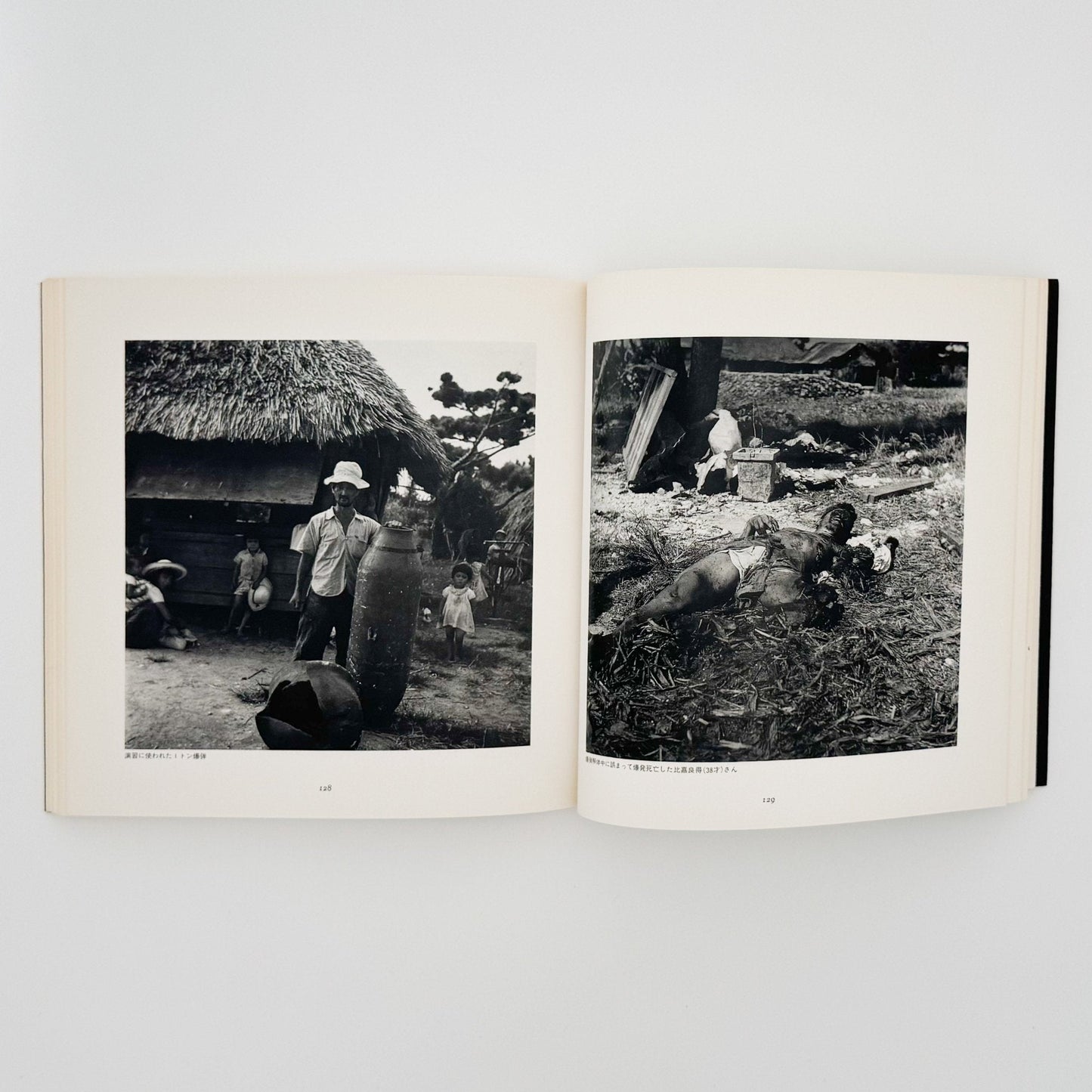
Shoko Ahagon: Photographic Record, An Island Where People Live: Records of the Land Struggle on Iejima, Okinawa
Shoko Ahagon: Photographic Record, An Island Where People Live: Records of the Land Struggle on Iejima, Okinawa
Couldn't load pickup availability
Shoko Ahagon (1901–2002) continued his nonviolent land struggle against the U.S. military on Ie Island, Okinawa.
In the midst of this struggle, he took a twin-lens reflex camera and recorded the daily events in his photo book, The Island Where People Live.
In the early hours of March 11, 1955, the residents were forcibly stripped of their homes and farmland to make way for the US military to expand its base, a violent seizure known as "bayonets and bulldozers." Ahagon and his colleagues used their cameras to visualize destroyed homes, living in tents, violence by US soldiers, damage caused by military exercises, and even the pilgrimages known as "beggars' marches," conveying to the outside world the reality of a remote island that was otherwise invisible.
This book captures the essence of the Iejima land struggle. It is notable for its continuous records that capture the humidity of daily life and the weight of time, rather than harsh news photographs. It is also of great historical value as the only photo collection left by Ahagon, who would later be called the "Gandhi of Okinawa."
[Title] Photographic Record: An Island Where People Live: Records of the Land Struggle on Iejima, Okinawa
[Publisher] Private edition
[Date of publication] December 25, 1982 (first edition)
[Number of pages] 168 pages
[Size] Approx. 25.8 x 25 x 2.1 cm, 0.93 kg
[Format] Softcover
[Title reading] Photo Record: Island of Humanity: Okinawa and Tochitoso's Record
[Author/Editor, etc.] Shoko Ahagon/Author
[Print] 491
[ISBN] None
[Condition] Used [6] Above average (box slightly damaged, slight stains, overall slight discoloration of the book)
[Accessories] Box, Asahi Shimbun clipping introducing Mr. Ahagon (dated June 13, 1984)
[Featured books]
[Related Exhibition] Tokyo Polytechnic University, Faculty of Art, Shadai Gallery, Masahiro Ahagon Photography Exhibition "Islands Inhabited by Humans" November 5, 2024 – January 31, 2025
Ahagon Shoko (1901–2002)
Born in 1901 in Kamimotobu Village, Okinawa Prefecture (now Motobu Town).
At a young age, he emigrated to Cuba and Peru as an agricultural immigrant, returning to Japan in 1934.
While running a general store, he aspired to establish a farmer's school, but his plans were thwarted by the war and the subsequent land seizure by the US military.
In 1955, he began a non-violent land struggle with the local residents of Iejima, laying the foundation for the "island-wide land struggle" that would later spread to the entire prefecture. In 1984, he founded "Wabiai no Sato," which includes the "Nuchidu Takara House Anti-War Peace Museum" and the "Yasuragi House," and made it a base for peace activities.
His books include "The US Military and the Farmers" (Iwanami Shinsho, 1973), "The Island Where Humans Live" (1983, privately published), a photo collection of his own photographs, and "Life is the Treasure: The Spirit of Okinawa's Anti-War Movement" (Iwanami Shinsho, 1992). In 1994, he received the Okinawa Prefecture Merit Award. In 2024, he received the Sagamihara Photography Award for the exhibition "Photography, Resistance, and the Island People" (Maruki Gallery of Atomic Bomb Art).
March 21, 2002, due to pneumonia He passed away in Tomigusuku Village, Okinawa Prefecture (now Tomigusuku City) at the age of 101.
< Related Figures >
Shoko Ahagon