Nobuyoshi Araki's fake diary
Nobuyoshi Araki's fake diary
Couldn't load pickup availability
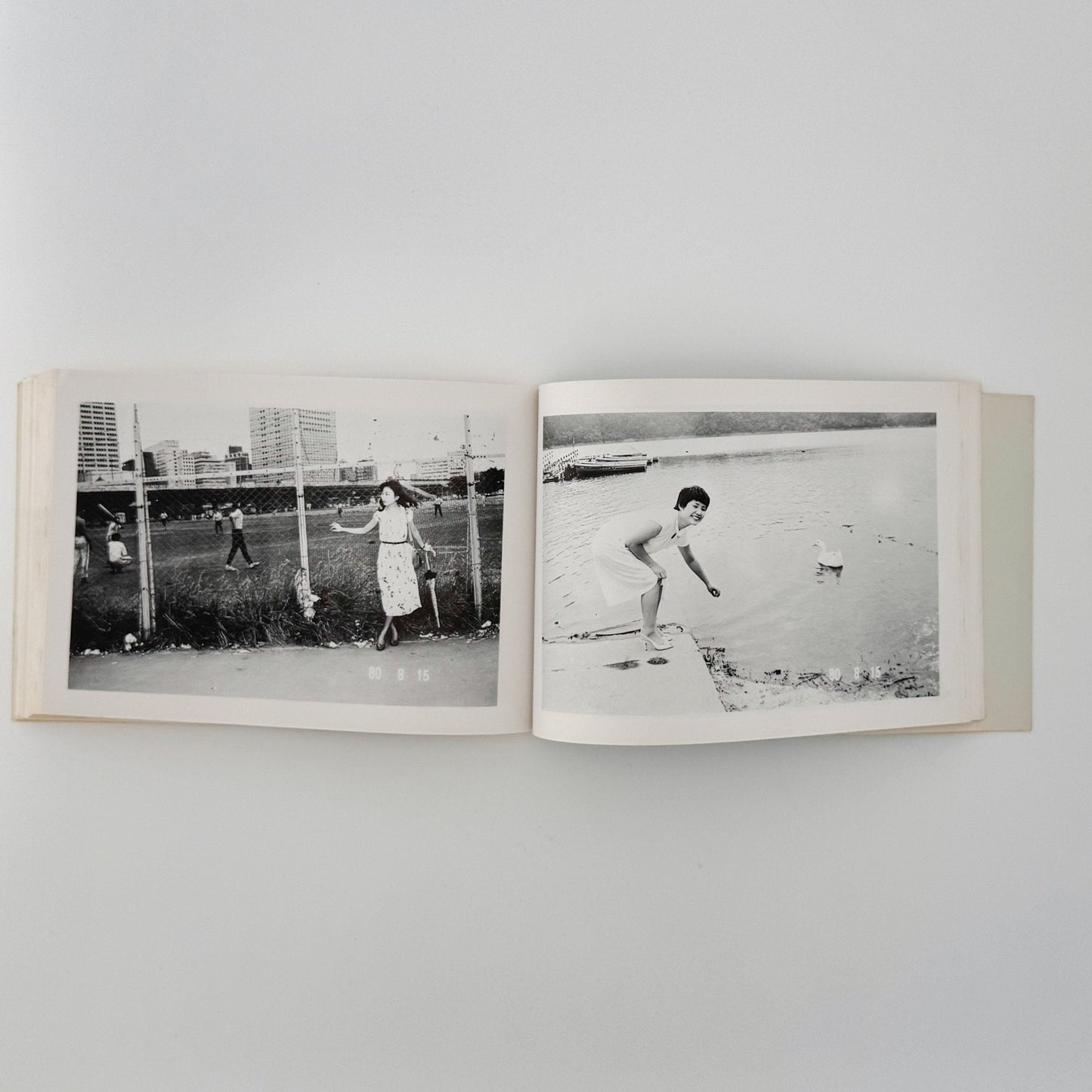
This photo book by Nobuyoshi Araki was published when his collaboration with editor Akira Suei became more active, from the late 1970s to the 1980s. Published in the same year as "Pseudo-Reportage," this book fully introduced the "dated snapshot" methodology that would define Araki's later work.
In this book, dated snapshots are arranged one per page, in order from April 1, 1979, but the end of the book suddenly jumps to 1992. This is a "pseudo" trick caused by Araki arbitrarily changing the date setting on his camera at the time, and the core of this work lies in the chronological discrepancies and the mixing of reality and fiction. From female nudes, cityscapes, funeral scenes, to a scene from Seijun Suzuki's "Zigeunerweisen," Araki's daily life, fantasies, and emotional nuances continuously emerge.
For Araki, who stated that "taking photos with dates is my life and my diary," this work marks the starting point of his "photo diary" style and connects to his extensive series of private photographs that followed. At the end of the book, Masaaki Hiraoka (critic, writer, jazz critic, cultural critic) contributed an essay.
[Title] Araki Nobuyoshi no Nise Nikki (Nobuyoshi Araki's Pseudo Diary)
[Publisher] Byakuya Shobo
[Publication Date] November 10, 1980 (1st printing)
[Page Count] Unpaginated
[Size] Approx. 26.2 x 17.6 x 2.0 cm, 0.80 kg
[Format] Softcover
[Title Reading] ARAKI NOBUYOSHI NO NISENIKKI
[Author/Editor] Nobuyoshi Araki/Author, Hiroto Fukuda/Production, Akira Suei/Book Design
[Printing] Nihon Seihan/Printing and Binding
[ISBN] None
[Condition] Used 【5】Good (Slight sunning and minor damage to slipcase, foxing on edges)
[Accessories] Slipcase
[Featured In]
[Related Exhibitions]
Nobuyoshi Araki
Born on May 25, 1940, in Minowa, Taito-ku, Tokyo.
In 1959, he entered Chiba University, Faculty of Engineering, Department of Photography and Printing, and graduated in 1963. After graduation, he joined Dentsu and worked as an advertising photographer. In 1964, he received the 1st Taiyo Award for "Sacchan," establishing himself as a photographer.
In 1971, he published "Sentimental Journey," a private photo book documenting his honeymoon with his colleague Yoko Aoki, establishing the "I-photography" style. In 1972, he left Dentsu to become a freelance photographer, capturing a wide range of subjects including nudes, urban landscapes, flowers, his beloved cat Chiro, his daily life with his wife Yoko, and street snapshots. His style, which brought fragments of daily life and personal emotions to the forefront, created a new trend in the photography world.
From the 1980s onward, he developed dense daily photographs using medium format cameras such as the Pentax 67 and Plaubel Makina 67, as well as Leica. He pursued expressions that blurred the boundaries between private and public spaces with an intimate gaze towards his subjects and moist depictions. He has published over 500 photo books and is highly acclaimed both in Japan and internationally.
His major photo books include "Sentimental Journey" (1971), "Tokyo Diary" (1977), "Shakyo Rojin A" (1990), "Shashin Shijoshugi" (2000), and "Nobuyoshi Araki Photo Complete Works" (2008).
His awards include the Taiyo Award, the Austrian Decoration for Science and Art, the 6th Ango Award, and the 54th Mainichi Art Award Special Prize. He continues to actively photograph and is recognized internationally as one of Japan's leading contemporary photographers.
< Related Figures >