Here is JAPAN No. 2
Here is JAPAN No. 2
Couldn't load pickup availability
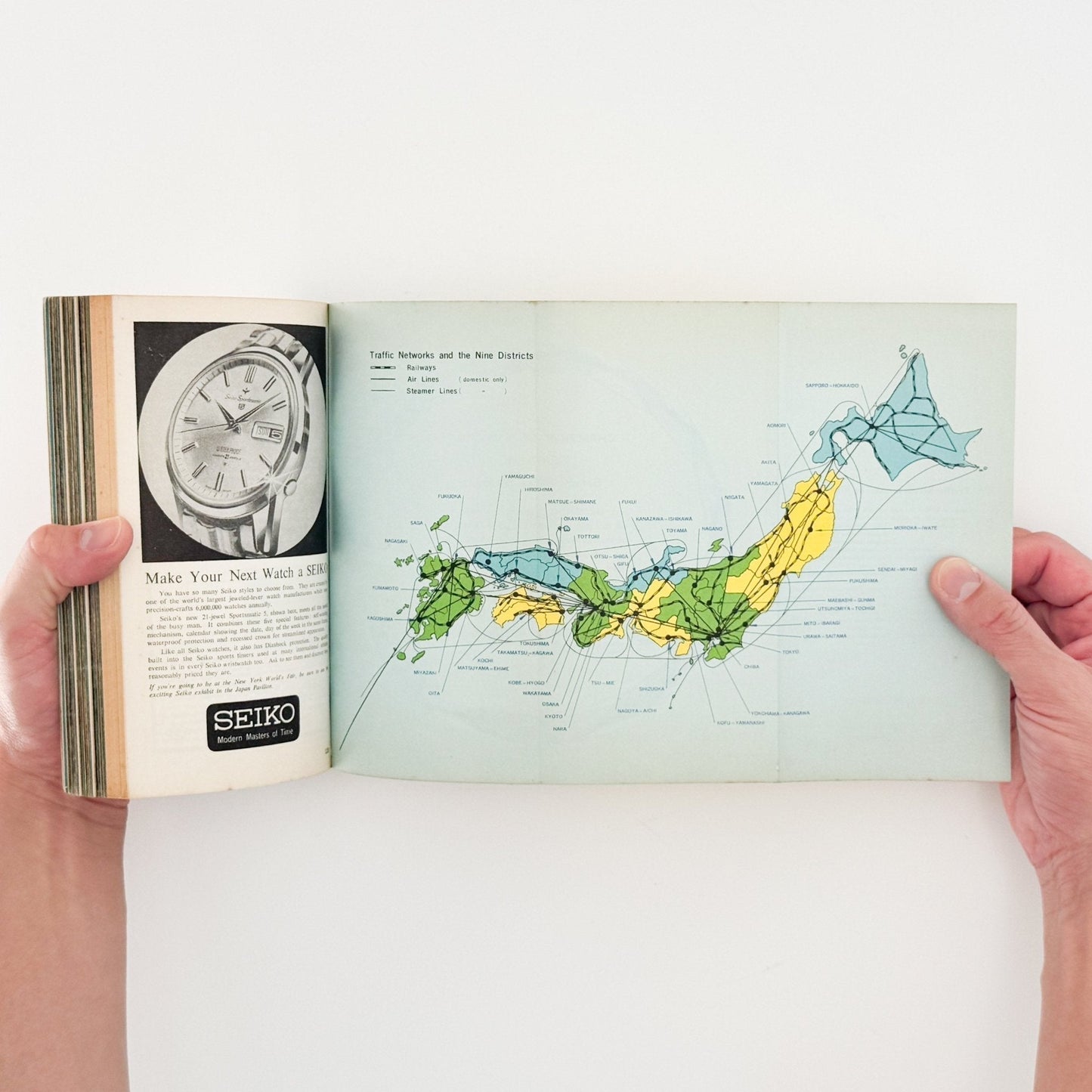
This guidebook introducing Japan to foreigners was published by Asahi Broadcasting Corporation in 1964. With the Tokyo Olympics approaching, it was produced to convey Japanese culture, cities, landscapes, and industry from various angles to foreign tourists visiting Japan. 200,000 copies of the second issue alone were printed, and many of them were distributed to passengers on Pan American World Airways flights.
The editorial advisors include Hidetoshi Kato, Minoru Oda, Sakyo Komatsu, Tadao Umesao, Takeo Kuwabara, and Taro Okamoto. Awazu Kiyoshi is in charge of art direction, and the book is primarily composed of photographic illustrations. Ten of Japan's leading postwar photographers, including Eikoh Hosoe, Hiroshi Hamaya, Shigekazu Nagano, Ken Domon, Munekazu Inoue, Seiji Otsuji, Shomei Tomatsu, Yasuhiro Ishimoto, Yukichi Watanabe, and Yukio Futagawa, participated in the book, presenting powerful images across the first 200 pages.
While the first issue, published the previous year, was centered around a cover design by Hayakawa Yoshio and illustrations by Manabe Hiroshi, this issue takes a major turn by presenting "Japan" through photography. Covering everything from the dynamism of cities to traditional culture, climate, and industrial sites, it visually conveys the state of Japan's postwar reconstruction. It is a book that symbolizes the era, crystallizing the characteristics of a medium produced ahead of a national event and the work of photographers at the forefront of the time.
[Title] Here is JAPAN No. 2
[Publisher] ASAHI BROADCASTING CORPORATION
[Date of publication] 1964
[Number of pages] 206 pages
[Size] Approx. 105*180*20mm, 386g
[Format] Softcover
[Language] English
[Title Reading] Here is Japan Go
[Authors, editors, etc.] Awazu Kiyoshi/cover design, text layout, illustrations, Hosoe Eikoh/photographs, Hamaya Hiroshi/photographs, Nagano Shigekazu/photographs, Domon Ken/photographs, Inoue Munekazu/photographs, Otsuji Seiji/photographs, Tomatsu Shomei/photographs, Ishimoto Yasuhiro/photographs, Watanabe Yukichi/photographs, Futagawa Yukio/photographs
[printing]
[ISBN] None
[Condition] Used [4] Average to below average (discoloration due to age, slight damage to edges, slight scratches on front and back covers, slight stains on three sides)
[Accessories] Fuji Bank Yen-Dollar Conversion Chart Bookmark (1 sheet)
[Featured book] BOOKS ON JAPAN 1931-1972: A graphic magazine of Japanese foreign affairs (BNN Shinsha)
[Related Exhibitions]
Kiyoshi Awazu (February 19, 1929 - April 28, 2009)
Born in Meguro Ward, Tokyo.
After dropping out of the Hosei University Specialization Department, he self-taught himself in painting and design techniques, and distinguished himself with his highly painterly graphic expressions that combined precise line drawings with chaotic colors.
In 1955, he won the Nissenbi Award at the Japan Advertising Artists Association Exhibition. In 1960, he joined the Metabolism movement together with other architects, and developed collaborations in architecture and urban planning. He served as an assistant professor in the Department of Commercial Design at Musashino Art University, and devoted himself to nurturing the next generation of designers.
In the late 1960s, he founded the "Environment" group and was involved in the planning of the theme pavilion and aerial exhibitions at the Osaka World Exposition. He has since participated in international projects both in Japan and abroad, working in a wide range of fields including posters, book covers, stage art, film art, murals, and environmental design. He is also known for his collaboration with architect Hiroshi Hara.
He was awarded the Medal with Purple Ribbon in 1990 and the Order of the Rising Sun, Fourth Class, Gold Rays with Rosette in 2000. He served as the first director of the Printing Museum of Japan from 2000 to 2005. He passed away from pneumonia in 2009. He was one of Japan's leading postwar creative artists who continued to transcend the boundaries of graphic design.
< Related Figures >
Hidetoshi Kato, Minoru Oda, Sakyo Komatsu, Tadao Umesao, Takeo Kuwahara, Taro Okamoto, Kiyoshi Awazu, Eikoh Hosoe, Hiroshi Hamaya, Shigekazu Nagano, Ken Domon, Munekazu Inoue, Seiji Otsuji, Shomei Tomatsu, Yasuhiro Ishimoto, Yukichi Watanabe, Yukio Futagawa