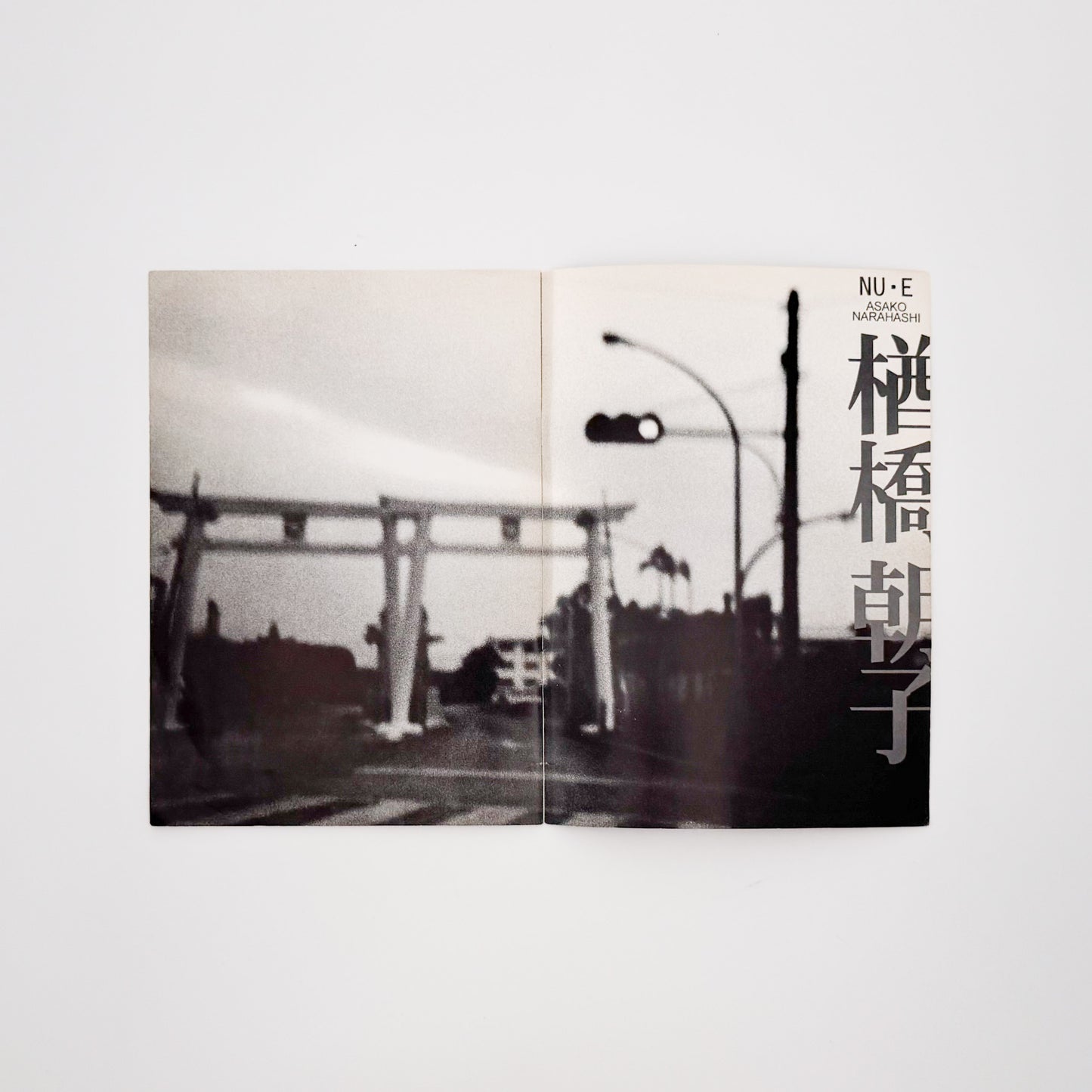
FOTO MAGAZINE Man No. 1
FOTO MAGAZINE Man No. 1
Couldn't load pickup availability
The first issue of 'main', a photography magazine founded in 1996 by Miyako Ishiuchi and Asako Narahashi, two of Japan's leading photographers.
The title "main" is a combination of their initials and also derives from the French word "main" meaning "hand." Although it was self-produced and self-published by two women, it was not merely a zine or mini-comic, but became one of the interesting movements in Japanese photography after the 1990s.
At a time when camera magazines were losing their momentum, Ishiuchi and Narahashi chose to create their own "venue for presenting ongoing work." Each issue featured their respective works, as well as dialogues, photo book reviews, and guest introductions. One can feel their intention to record and preserve photographs not only as "exhibitions" but also as a time-based medium like a magazine.
In the first issue, Asako Narahashi presented a series that would lead to her later masterpiece 'NU・E', while Miyako Ishiuchi presented "Fathers," documenting the death of her father. The issue also includes a text by Ishiuchi about Kikuji Kawada's 'The Map'.
A total of 10 issues were published from 1996 to 2000. It is a fascinating series for considering independent photographic expression, self-publishing culture, and the history of women photographers' activities.
[Title] FOTO MAGAZINE main (man) No. 1
[Publisher] main Editorial Office
[Publication Date] March 3, 1996
[Number of Pages] 30 pages
[Size] Approx. 183*257*2mm / 88g
[Format] Softcover
[Language] Japanese
[Title Reading] MAN 1 GO
[Author/Editor] Miyako Ishiuchi
/Author/Editor/Publisher, Asako Narahashi/Author/Editor/Publisher, Tetsuya Ishizuka/Design
[Printing] Gendaisha/Printing
[ISBN] None
[Condition] Used [4] Good (Body: slight spine damage, slight corner fold)
[Accessories] None
[Featured in] -
[Related Exhibitions] -
Miyako Ishiuchi (Ishiuchi Miyako) 1947-
Born in Gunma Prefecture. Photographer.
Dropped out of Tama Art University, Department of Textile Design. Began photography in the 1970s and gained significant attention with 'APARTMENT', self-published in 1978, followed by 'Yokosuka Story' and 'Renya no Machi'.
Starting from Yokosuka, a US military base town where she spent her childhood, she consistently photographed themes such as the traces of America left in post-war Japan, urban memories, the body, clothing, and the traces of time. From her early works characterized by rough grain and strong contrast to her later works focusing on scars, relics, and clothing, she has established a unique position in the history of Japanese photography.
In the 1980s, she presented works on the theme of the female body of her generation, such as "Classmates" and "1・9・4・7". From the 1990s onwards, she developed works such as "scars," "Mother's," and "Hiroshima," quietly capturing memories, death, and traces of existence through scars engraved on the body, atomic bomb relics, and her mother's clothes and personal belongings.
In 2005, she was selected as the representative artist for the Japan Pavilion at the 51st Venice Biennale. In 2014, she received the Hasselblad International Award, an international award in photography. She is highly regarded both domestically and internationally as one of Japan's leading photographers.
Her major awards include the Photographic Society of Japan Newcomer's Award (1979), the 11th Kimura Ihei Award (1981), the 50th Mainichi Art Award (2009), and the Hasselblad International Award (2014).
Her works are housed in museums around the world, including the Museum of Modern Art, New York, Tate Modern, the Metropolitan Museum of Art, the National Museum of Modern Art, Tokyo, the Tokyo Photographic Art Museum, and the San Francisco Museum of Modern Art.
Asako Narahashi (Narahashi Asako) 1959-
Born in Tokyo. Photographer.
Graduated from Waseda University, Second Faculty of Letters, majoring in Fine Arts. In the mid-1980s, while still a student, she participated in Daido Moriyama's workshop "Photo Session." In 1989, she held her first solo exhibition, "Spring is Dawn," and the following year, 1990, she established the independent gallery "03FOTOS." This space, which operated until 2001, became one of the important bases for independent expression and self-publishing culture in Japanese photography after the 1990s.
In 1997, she published her first photo book, 'NU・E'. She gained attention for her works capturing cities, aquariums, and nightscapes with a unique sense of color and distance.
Around 2000, she began her representative series "half awake and half asleep in the water," in which she photographs while floating on the water's surface. The scenes, where the sense of horizontal equilibrium is disrupted, captured while drifting in the sea or a lake, possess a unique sensation of hovering between dream and reality, and have received high acclaim both domestically and internationally.
Subsequently, she released 'Ever After', 'Approaching and Distancing', 'Biwako', and 'Spring is Dawn'. Characterized by quiet colors, a sense of buoyancy, and a bodily perspective, she continues to create works on the themes of cities, watersides, travel, and the sense of time.
She also co-published the photo magazine 'main' (1996-2000) with Miyako Ishiuchi, playing an important role in the independent publishing and self-gallery culture.
Her major awards include the Photographic Society of Japan Newcomer's Award (1998), the 16th Photo Society Award (2004), and the 24th Higashikawa Award Domestic Artist Prize (2008).
Her works are housed in museums both in Japan and abroad, including the Tokyo Photographic Art Museum, the National Museum of Modern Art, Tokyo, the San Francisco Museum of Modern Art, the Museum of Fine Arts, Houston, and the J. Paul Getty Museum.
< Related Figures >
Kikuji Kawada, Daido Moriyama, Masumi Kura