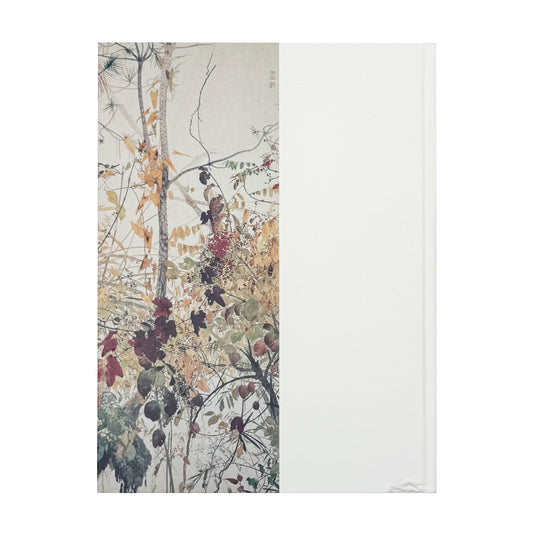
Ito Jakuchu ― Another World ―
Ito Jakuchu ― Another World ―
Couldn't load pickup availability
The official exhibition catalog for “Ito Jakuchu: Another World,” which introduced the diverse pictorial expressions of mid-Edo period artist Ito Jakuchu (1716–1800), with a focus on his ink paintings. It was published in conjunction with the exhibition held at the Shizuoka Prefectural Museum of Art and the Chiba City Museum in 2010.
While Jakuchu is widely known for his colored paintings, such as the “Colored Paintings of Animals and Plants,” characterized by meticulous detail and vivid colors, he also produced numerous ink paintings throughout his life. This exhibition re-examines Jakuchu’s artistic career, which has hitherto been discussed primarily in terms of his colored paintings, through the techniques and formal characteristics of his ink works.
The plates are organized into four chapters: “Prehistory of Jakuchu,” “Early Works: A Period of Exploration,” “Colored Paintings and Ink Paintings,” and “Later Years: Diverse Developments.” They introduce works by the monk-artist Kureitei and others that exemplify ink painting before Jakuchu, as well as Jakuchu’s early works and later ink paintings. Particular attention is paid to his original techniques, such as “sujimoku-gaki,” which uses ink bleeding to create white outlines, depictions made of countless dots, and expressions using grid-like compartments.
Through works such as the “Folding Screen of an Elephant and a Whale” and “White Elephant and Animals,” the exhibition traces the bold compositions and original sense of form that Jakuchu pursued. It also touches on ink-rubbing prints and multicolor woodblock prints based on rubbings, introducing how Jakuchu’s expressive range extended beyond painting into a variety of techniques.
The final section includes Tadashi Kobayashi’s “The Diverse Pictorial World of Ito Jakuchu,” Murasaki Ito’s “Ito Jakuchu as a ‘Chinese-Style’ Painter,” Yuya Fukuji’s study on the chronology of works through seal analysis, and Mitsuyo Ishigami’s study of “White Elephant and Animals.” Explanations of works, a list of seals, colophons, an abridged chronology, major references, and a list of works are also included.
This exhibition catalog provides a detailed examination of the techniques and forms of Edo period painting, focusing on Jakuchu’s ink expressions, which differ from his magnificent colored paintings.
[Title] Ito Jakuchu: Another World
[Publisher] Mangosteen
[Publication Date] April 10, 2010
[Number of Pages] 340 pages
[Size] Approx. 227 × 300 × 24 mm / 1496 g
[Format] Softcover
[Language] Japanese, English (in part)
[Title Reading] Ito Jakuchu: Another World
[Author/Editor/etc.] Ito Jakuchu (artist); Chiba City Museum (Murasaki Ito) and Shizuoka Prefectural Museum of Art (Yuya Fukuji, Mitsuyo Ishigami) (editors); Masayuki Kondo (design), etc.
[Printing/Binding] New Color Photo Printing Co., Ltd. (production)
[ISBN] -
[Condition] Used [5] Good (minor scratches on the top of the cover)
[Accessories] -
[Included Books] -
[Related Exhibition] “Ito Jakuchu: Another World” | Shizuoka Prefectural Museum of Art (April 10–May 16, 2010), Chiba City Museum (May 22–June 27, 2010)
Ito Jakuchu (1716–1800)
Born in Kyoto in 1716. A mid-Edo period painter. He was born the eldest son of Masugen, a greengrocer in Kyoto’s Nishiki-koji. From early childhood, he became familiar with painting and studied the techniques of the Kano school and Chinese painting.
He carefully observed the animals and plants around him and developed original descriptive techniques, particularly by repeatedly sketching chickens. In 1755, he handed over the family business to his younger brother and devoted himself fully to painting.
From around 1757, he worked on his masterpiece, the “Colored Paintings of Animals and Plants,” expressing birds, fish, flowers, and plants with meticulous detail and vivid colors. In his ink paintings, he also employed original techniques that made use of the properties of paper and ink, such as “sujimoku-gaki,” which uses ink bleeding, and stippling.
In addition to painting, he also worked on ink-rubbing prints and multicolor woodblock prints, producing works such as “The Pleasure Boat,” “The Jade Pavilion of the Imperial Garden,” and “The Scroll of Simple Elegance.” He interacted with cultural figures in Kyoto, including the Zen monk Daisen Kenjo.
He continued to work vigorously until his later years and passed away in Kyoto in 1800. His masterpieces include the “Colored Paintings of Animals and Plants,” “White Elephant and Animals,” “Folding Screen of an Elephant and a Whale,” and “Group of Chickens.”
< Related Figures >
Ito Jakuchu
Kureitei
Tadashi Kobayashi
Chiba City Museum
Shizuoka Prefectural Museum of Art


You may also like
-
Ono Bakufu Exhibition: "The Great Japanese Fish Collection" and Fishes in Natural History Illustrations
Vendor:大野麥風 / OHNO BakufuRegular price ¥6,500Regular price -
A New Complete Picture
Vendor:田中一村 / TANAKA IssonRegular price ¥2,300Regular price -
200 years after the death of Aodo Denzen: The creative trajectory of a Western-style painter in the Edo period
Vendor:亜欧堂田善 / AODO DenzenRegular price ¥3,300Regular price¥5,500Sale price ¥3,300Sale -
Kanda Nissho: Brushstrokes to the Earth
Vendor:神田日勝 / KANDA NisshoRegular price ¥2,500Regular price