Kiyoshi Niiyama's Posthumous Works: A Poem of Wood and Stone
Kiyoshi Niiyama's Posthumous Works: A Poem of Wood and Stone
Couldn't load pickup availability
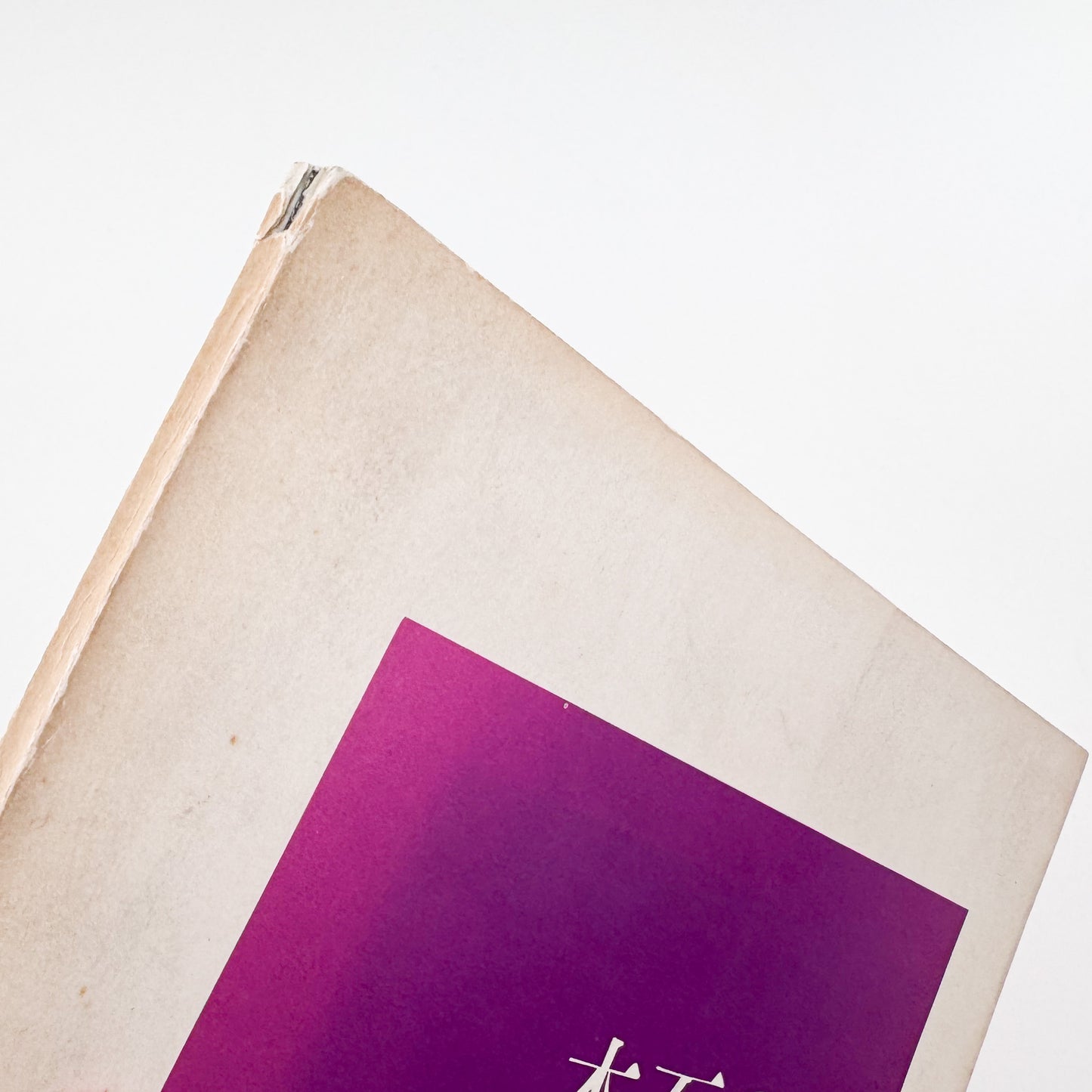
The posthumous collection of Kiyoshi Niiyama's works, "Mokuseki no Uta" (Poetry of Wood and Stone). After Niiyama's sudden death in May 1969, photographers who had been close to him during his lifetime planned a retrospective exhibition. Following the exhibition at the Pentax Gallery, the photobook was published the following year, in 1970. It contains 40 plates.
In 1936, he began his photographic activities as a member of the Parlette Camera Group. At the RIKEN Institute, he was also involved in camera design, and after the war, he continued to instruct amateur photographers at the All Japan Photographic Federation and the Tokyo Photographic Research Group. In 1958, he joined Asahi Optical, where he continued to photograph while serving as the director of the Tokyo Service Center.
This book organizes Niiyama's works by period, including his Parlette era, Matsuyama era, and Asahi Optical era. Black and white photographs of dead trees, trees, stones, tidal flats, towns, and people are included. Hiroshi Hamaya recalled that Niiyama's photographs, while having a sense of form, also showed strong empathy for the subjects, which expressed a unique Japanese aesthetic. The contributed essays also reveal his strong commitment to print quality, emphasizing enlargement as the final stage of creation.
The book includes eulogies by Seiji Akiyama, Tomohisa Iwama, Shoji Ueda, Hiroshi Hamaya, and Yoichi Midorikawa. Niiyama as a camera designer, Niiyama as a fellow photographer, and Niiyama as a photographer who repeatedly gazed at wood and stone emerge from their respective memories. This posthumous collection brings together Niiyama's works and the words of those around him in one volume. It is included in "The Japanese Photobook 1912–1990."
[Title] Kiyoshi Niiyama Posthumous Collection: Mokuseki no Uta
[Publisher] Yoichi Niiyama
[Publication Date] May 10, 1970
[Page Count] 60 pages
[Illustrations] 40 plates
[Size] Approximately 230 x 209 x 8mm / 290g
[Format] Softcover
[Language] Japanese
[Title Reading] NIIYAMA KIYOSHI ISAKUSHUU MOKUSEKI NO UTA
[Author/Editor] Kiyoshi Niiyama / Photographs, Seiji Akiyama, Tomohisa Iwama, Shoji Ueda, Hiroshi Hamaya, Yoichi Midorikawa, et al. / Contributions
[Printing/Binding] -
[ISBN] -
[Condition] Used [4] Good to Fair (minor spine damage repair/partial loss, faded spine, scuffed/soiled back cover, minor spotting on edges, bookstore sticker on endpaper)
[Accessories] -
[Included in] The Japanese Photobook 1912–1990
[Related Exhibition] "Mokuseki no Uta" Kiyoshi Niiyama Retrospective Exhibition, 1969, Pentax Gallery
Kiyoshi Niiyama (1911–1969)
Born in Ehime Prefecture in 1911. Photographer.
After graduating from Tokyo Electrical Engineering College, he joined the RIKEN Institute in 1935. In 1936, he began photography with a Parlette 6.3 camera and joined the Parlette Camera Group. He published his works in domestic photography magazines, salons, the Kokuten (National Art Exhibition), and the Nika Exhibition, and was also selected for salons in London and Paris and American photography contests.
At the RIKEN Institute, he was also involved in camera design, and his involvement in the prototype of the domestically produced "GOKOKU" camera is noted in Tomohisa Iwama's eulogy. Subsequently, he served as an executive of the All Japan Photographic Federation and a judge for the Tokyo Photographic Research Group, also instructing amateur photographers nationwide.
In 1958, he joined Asahi Optical and became the director of the Tokyo Service Center. He continued his photographic work while maintaining his job, photographing dead trees, trees, stones, tidal flats, landscapes, and people. He was also strongly particular about print enlargement, viewing not only shooting but also the final printing as part of the creative process.
In the spring of 1969, he visited Taiwan for photography, and the photographs taken by Xu Qingbo in Taiwan became his last portraits. He passed away on May 13 of the same year.
< Related Figures >
Shoji Ueda
Hiroshi Hamaya
Yoichi Midorikawa
Hachiro Suzuki
Seiji Akiyama
Tomohisa Iwama
Xu Qingbo
Otto Steinert