Discovering François Pompon: From the Collection of Works and Materials at the Gunma Museum of Art, Tatebayashi
Discovering François Pompon: From the Collection of Works and Materials at the Gunma Museum of Art, Tatebayashi
Couldn't load pickup availability
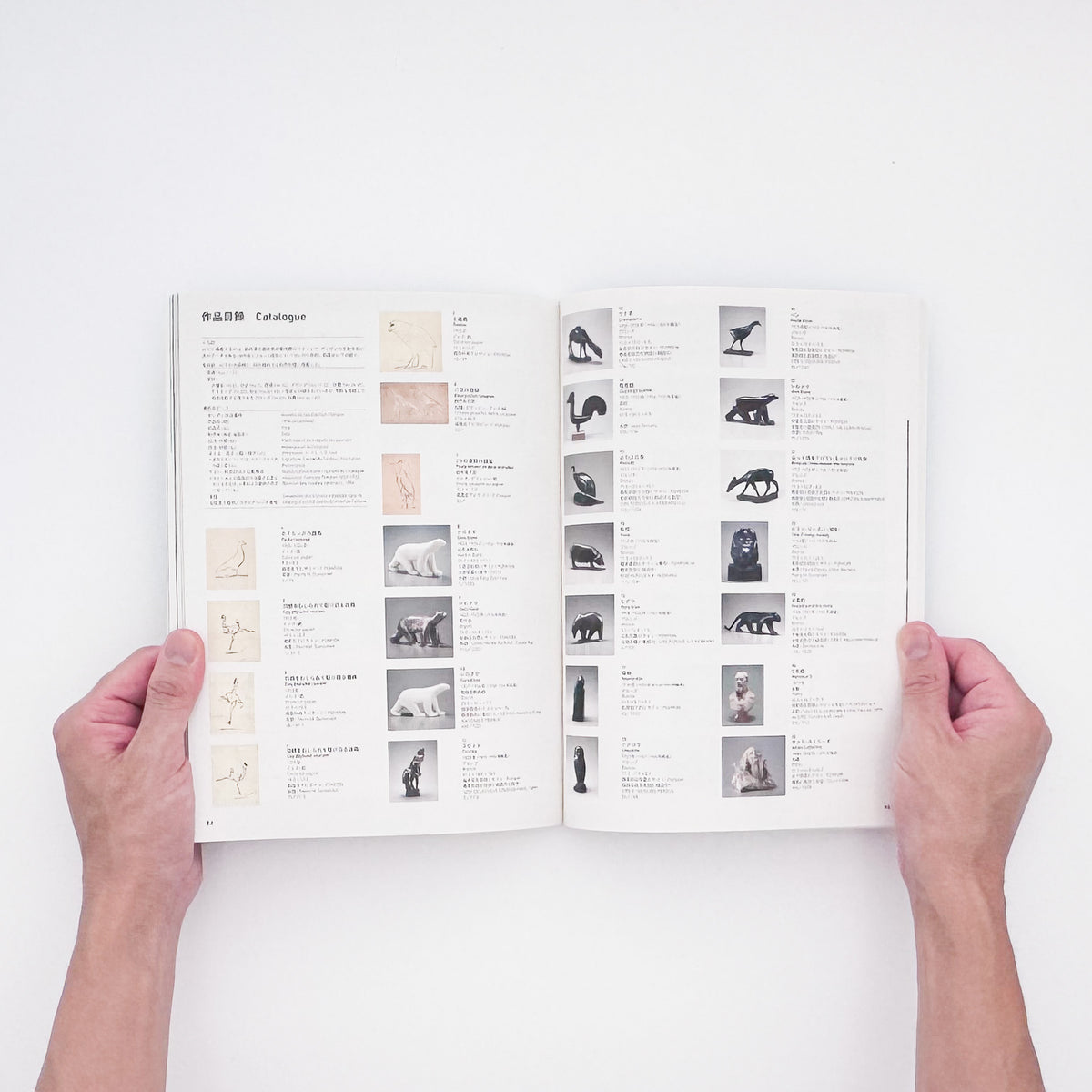
A guidebook introducing the life and work of sculptor François Pompon (1855–1933), who established a unique style in early 20th-century France through his smoothly simplified animal sculptures, drawing from the collection of the Gunma Museum of Art, Tatebayashi.
The Gunma Museum of Art, Tatebayashi, collects Pompon’s works as a representative artist for its theme of "Nature and Man," holding 67 pieces including the marble *Polar Bear*, as well as bronzes, stone carvings, terracottas, clay works, figurative sculptures, and sketches such as *Guinea Fowl*, *Brown Bear*, and *Great Panther*. The museum also houses over 1,200 related materials previously owned by Pompon, including tools, molds, notebooks, letters, photographs, postcards, and newspaper and magazine clippings.
This book traces Pompon’s career and life through illustrations of works in the collection and related materials. In addition to essays on "François Pompon’s Works and Their Era" and "The Introduction of Pompon’s Work in Japan," it presents his professional contributions through various perspectives, including his relationship with Rodin, his observations at the zoo, his ties to Normandy, Art Deco ornamentation, foundries, plasterwork, and his interest in ancient and medieval art.
The content is organized using both works and documentation, covering the transition from early figurative sculptures to animal sculptures, the birth of the *Polar Bear*, and his representative late works. By incorporating Pompon’s own words, descriptions of his personality by contemporaries, and glimpses of his studio, the book provides insights into the creative environment and philosophy behind his concise aesthetic.
[Title] Getting to Know François Pompon: From the Collection of Works and Materials at the Gunma Museum of Art, Tatebayashi
[Publisher] Gunma Museum of Art, Tatebayashi
[Publication Date] March 15, 2022 (2nd edition)
[Number of pages] 104 pages
[Dimensions] approx. 191×257×9mm / approx. 350g
[Format] Softcover
[Language] Japanese/French
[Title reading] François Pompon o shiru: Gunma Kenritsu Tatebayashi Bijutsukan Sakuhin/Shiryo Korekushon yori
[Author/Editor, etc.] Kazumi Matsushita/Writing & Editing, Reiko Kamio/Writing, Koji Kurihara (Kuri-Lab)/Design, erA/Production
[Printing/Binding] Tokyo Inshokan/Printing
[ISBN] -
[Condition] Used [8] Excellent to Very Good
[Included Items] 1 "Junior Guide," 1 exhibition catalog, 1 errata sheet
[Featured Book] -
[Related Exhibition] -
François Pompon 1855–1933
Born in 1855 in Saulieu, Burgundy, France. A sculptor known for animal sculptures characterized by smooth surfaces and simplified outlines, he introduced a new aesthetic to animal sculpture, which had previously been dominated by realistic representation.
Raised by a father who was a woodworking artisan, he began helping in the workshop from a young age. Aspiring to become a sculptor, he moved to Dijon around the age of 15; while apprenticing as a marble carver for gravestones, he studied architecture, printmaking, and sculpture in evening classes at an art school. The sense of precise form, rules, and balance he learned from his father would later inform his animal sculptures.
He later moved to Paris, where he produced figurative sculptures and worked as an assistant, notably in the studio of Auguste Rodin. Eventually shifting his focus from human figures to animals, he repeatedly observed and sketched at places like the zoo, seeking an expression that distilled the essence of his subjects into clear volumes and contours while refining the details.
He created works featuring various animals, such as bears, birds, and panthers, including his masterpiece, *Polar Bear*. By creating forms that not only faithfully captured nature but also retained the inherent movement and weight of the animals through simplification, he established a unique position in early 20th-century animal sculpture. Died in 1933.
< Related Figures >
François Pompon
Auguste Rodin
Gunma Museum of Art, Tatebayashi
Musée d'Orsay
Tokyo Inshokan


You may also like
-
The See-saw
Vendor:MARI Enzo / エンツォ・マリRegular price ¥4,400Regular price -
Amulet Zoo
Vendor:田淵曉 / TABUCHI AkiraRegular price ¥1,800Regular price -
The Sacred Dog of the Mountains
Vendor:鶴巻育子 / TSURUMAKI IkukoRegular price ¥2,800Regular price -
The Art of Eric Carle
Vendor:Eric Carle / エリック・カールRegular price ¥770Regular price -
Animals of Oaxaca VINTAGE OAXACAN WOOD CARVING
Vendor:岩本慎史 / IWAMOTO ShinjiRegular price ¥2,750Regular price -
François Pompon: Sculptor Who Loved Animals
Vendor:François Pompon / フランソワ・ポンポンRegular price ¥2,800Regular price