The See-saw
The See-saw
Couldn't load pickup availability
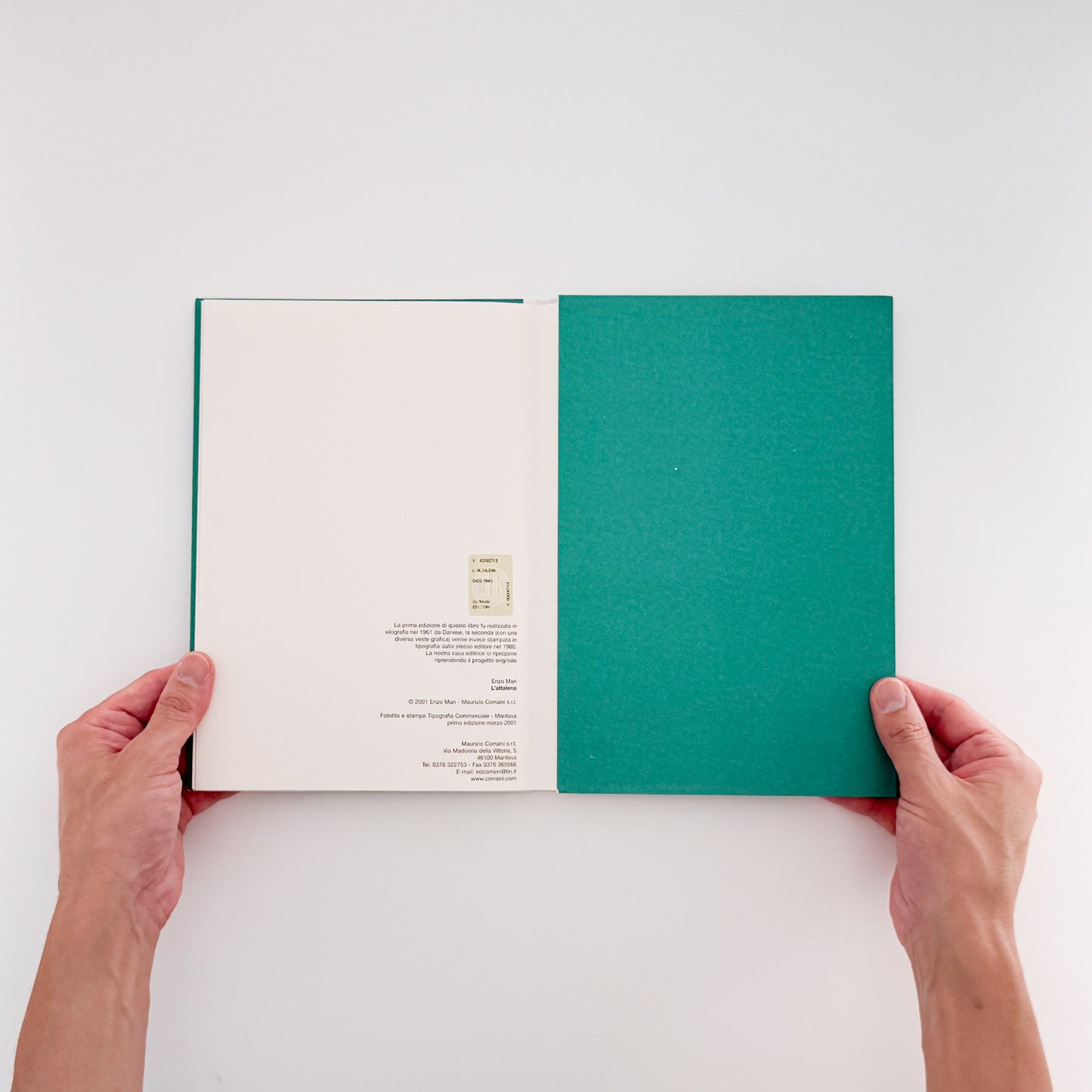
An accordion-fold picture book by Italian designer Enzo Mari. This edition, reissued by Corraini Edizioni in 2001, is based on the composition of the first edition, published by Danese in 1961 as a woodblock print.
When the accordion folds are opened, a continuous sequence of scenes unfolds, showing various animals, large and small, arranged on a seesaw, maintaining balance through their individual weights and shapes. Without using text, the composition conveys the relationships between weight, quantity, shape, movement, and balance solely through the arrangement of animals and the visual progression.
In addition to turning pages like a regular book, it can be spread out long and viewed, hung on a wall, or enjoyed as a game to consider the animals' balance. Although a children's picture book, Mari's design philosophy is evident in the simplified forms, limited colors, and the design of time and space utilizing the accordion binding.
This reissue was reproduced while preserving the feel of the paper, binding, and graphics used in the first edition. It is a book that transforms the act of seeing into an experience, without separating form and perception, or play and learning.
[Title] L’altalena / See-saw / Balançoire / Die Wippe
[Publisher] Corraini Edizioni
[Publication Date] March 2001
[Page Count] 28 pages
[Size] Approx. 242 x 168 x 5mm
[Format] Softcover, accordion binding
[Language] -
[Title Reading] Lal'talena
[Author/Editor] Enzo Mari/Author
[Printing] Tipografia Commerciale/Plate-making and Printing
[ISBN] 9788887942231
[Condition] Used [5] Good (Slight crease on edge)
[Accessories] -
[Featured In] -
[Related Books] "L’altalena"/Danese/1961, 1980
Enzo Mari (1932-2020)
An Italian-born designer, artist, and theoretician. He studied at the Brera Academy of Fine Arts in Milan and worked across a wide range of fields including product design, furniture, graphics, toys, picture books, exhibitions, and writing.
He developed designs that simplified forms while clearly indicating their structure and use. In his work with Danese, he created pieces that organized animals and plants into geometric outlines, as well as toys and picture books that encouraged children's perception and creativity.
< Related Figures >
Danese, Corraini Edizioni, Bruno Munari


You may also like
-
Amulet Zoo
Vendor:田淵曉 / TABUCHI AkiraRegular price ¥1,800Regular price -
The Sacred Dog of the Mountains
Vendor:鶴巻育子 / TSURUMAKI IkukoRegular price ¥2,800Regular price -
The Art of Eric Carle
Vendor:Eric Carle / エリック・カールRegular price ¥770Regular price -
Chinese Folk Toys Collection of the Japan Toy Museum
Vendor:尾崎織女 / OZAKI AyameRegular price ¥3,850Regular price -

 Sold out
Henry Moore's Sheep Sketchbook
Vendor:Henry MOORE / ヘンリー・ムーアRegular price ¥3,850Regular price